Overview
I led the strategic overhaul of PayByPhone's overly complex onboarding, successfully eliminating excessive screens to solve a major 17.8% user drop-off. Crucially, I designed this high-speed flow to be AI-ready, efficiently gathering the essential data needed to power predictive features like one-tap "Quick Park" and contextual service discovery.
My role
Product design lead
Team
1 Designer, 1 PM, 5 Devs
Duration
8 months
Release year
2024
Status
Approved for Launch (Going Live)
The Business Challenge: The Trade Off Between Speed and Data 🎯
The project had a critical, two part mission: to fix the immediate, costly loss of users AND strategically build the foundation for future personalized services.
1. Primary Goal: Fix User Friction and Loss (Addressing the Old Flow's Flaws)
The previous onboarding flow was fragmented, confusing, and required six unnecessary screens before a user could even register, leading to these critical issues:
High Drop Off: 17.8% of users were leaving before signing up because of the excessive number of screens before account creation.
Low Verification: Only 33% of users verified their phone, which jeopardized security and communications.
2. Secondary Goal: Enable Personalized Experiences
We needed a reliable way to collect key user data (like Fuel Type) to tailor the app and drive engagement with services beyond parking (like EV charging).
How Might We secure the funnel, stopping our high user drop-off, by designing a flow that is both Fast and Simple, yet completely AI-ready?
🧠 Phase 1: Strategy & Foundational Principles
My approach was to prioritize speed and strategic data collection, ensuring the user experience was built to support future Machine Learning models.
The Strategy: Speed First, AI Integration Second ✨
My strict priority as Design Lead was this: We must prioritize speed to fix the drop off, then progressively integrate the extra data collection steps.
Core Design Principles:
FAST & SIMPLE: Remove unnecessary screens and steps.
RESUMABLE: Never force users to complete optional tasks upfront.
AI READY LOGIC: Design the flow to enable predictive routing and data segmentation from Day 1.
🔍 Phase 2: Concept Exploration & Validation
The final design is the result of strategically combining the best ideas from our explorations and aggressively rejecting elements that added risk.
The Initial Problem Visualized
The original flow forced users through six distinct screens (Intro, Permissions, Welcome, etc.) before the actual registration form.
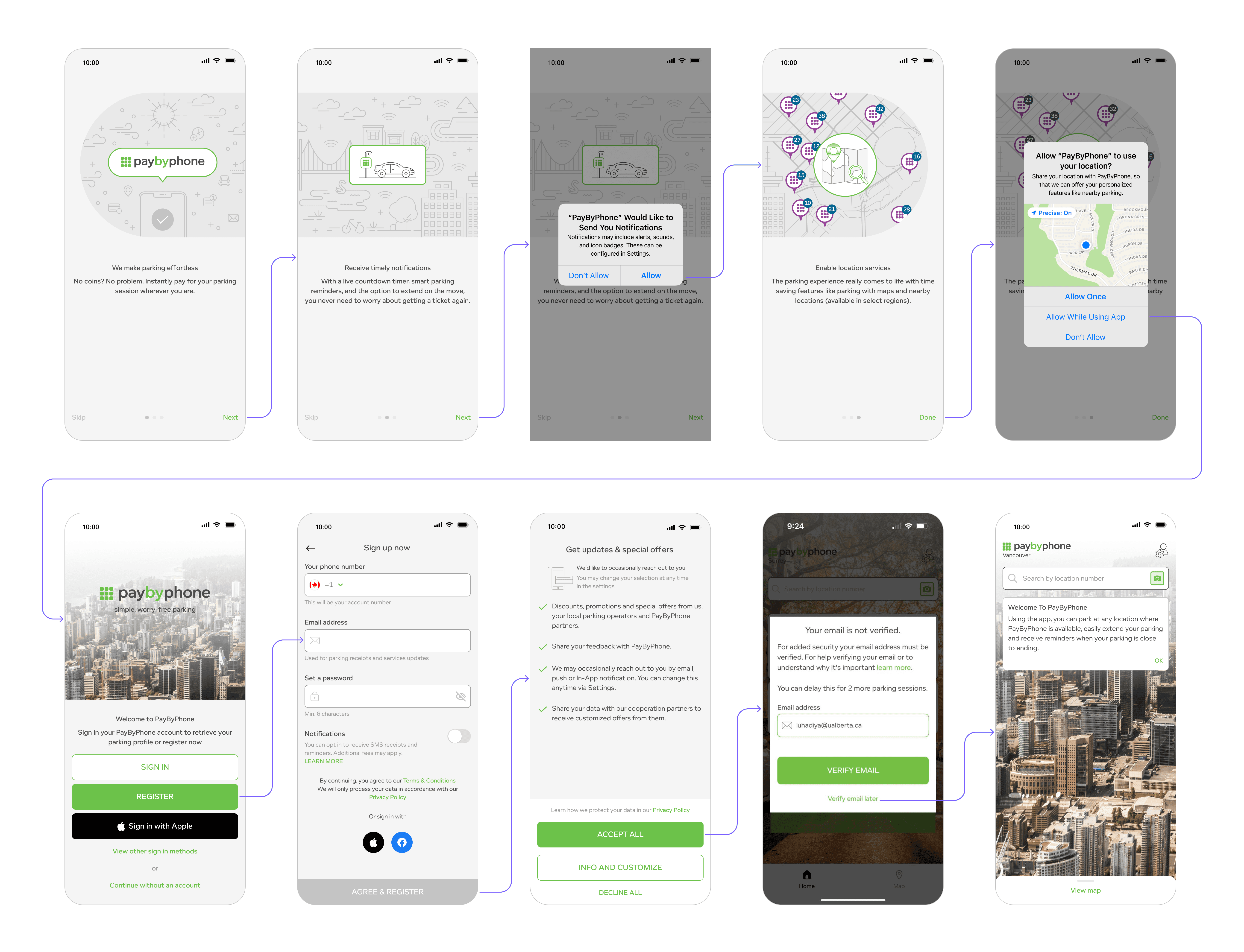
Original, High-Friction Flow
Exploration 1: Designing a Smarter, Friendlier Entry Flow
The Idea & Pivot: My initial concept introduced an animated carousel to quickly showcase value, offering a skip option to expedite the process. After reviewing user feedback and discussing with the team, we immediately rejected the carousel itself and the idea of presenting generic features (like "Extend Session"), as these added unnecessary complexity. However, I inherited and refined the crucial concepts: pattern-based routing for seamless registration/login and Resumable Onboarding to manage personalization data without slowing the initial sign-up.

Exploration 1: Animated Carousel & Resumable Onboarding Concept
Exploration 2: Location-Aware Onboarding with Focused Feature Education (Rejected)
The Rationale: I tested asking for location permission early to drive Product Awareness. The goal was to immediately show relevant, city-specific services instead of repeating generic parking features users already expect. However, after discussion with the PM and engineering, we ultimately rejected this concept entirely because the friction of the permission request occurred too early, increasing the drop-off before registration could complete. This decision confirmed my core principle: The tactical goal (fixing the drop-off) must always outweigh the strategic goal (awareness) at the entry point.

Exploration 2: Location-Aware Onboarding
📐 Phase 3: Final Solution & UX Execution
The final design eliminated unnecessary screens and focused on reducing cognitive load during the critical entry moment.
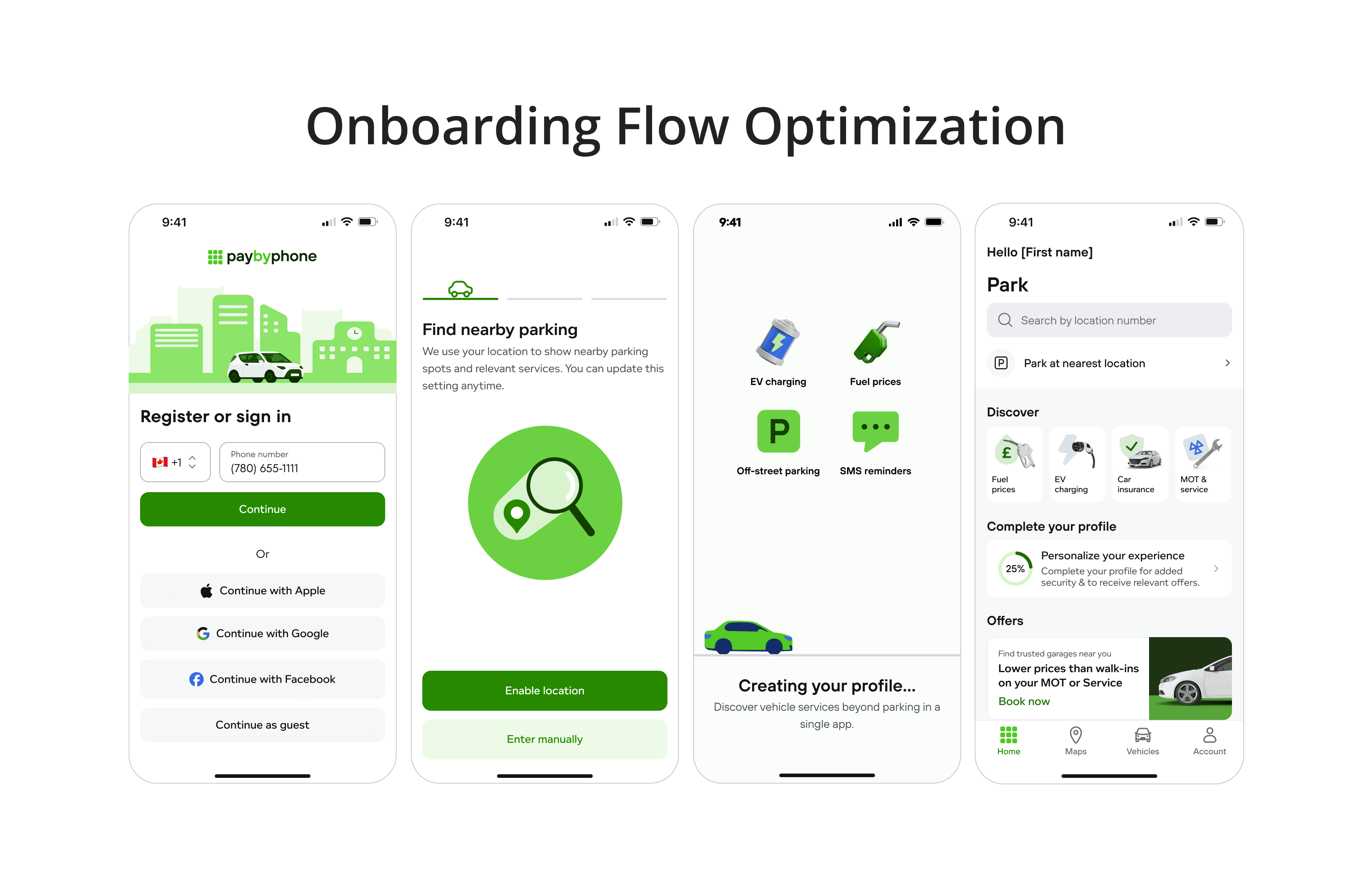
Final Design: The Optimized, AI Enabled Flow
The final solution clusters high friction setup tasks and enables key AI functionality:
Seamless Entry (Pattern Based Routing): The flow uses system logic on the phone number input. If the system detects an existing or partially registered user, they are automatically routed to the correct login or profile completion path. This pattern based routing eliminates unnecessary screens and is a key design feature for improving speed.
Contextual Verification (Fixing Low Verification): Verification is now a natural, contextual step within the registration path, rather than a disruptive interruption.
Progressive Onboarding (Enabling Personalization): The Resumable "Complete Your Profile" section collects data like Fuel Type and License Plate.
Design Rationale: This decision separates the high friction, one time Setup Task (LP entry) from the high frequency Transaction Task (parking payment), making the core app use frictionless. This collected data is the essential input for future AI services.

Final Design Screens: The Optimized, AI Ready Flow

Final Design Screens: The Optimized, AI Ready Flow (Prototype)
🤖 Phase 4: AI System Design & Value Creation
This dedicated phase details how the clean data collected during setup is leveraged to power continuous, high-value AI features.
Data Foundation: The Strategic License Plate Placement
The License Plate (LP) and Account Verification are mandatory in the setup phase because the AI needs high-integrity, verified data to function safely. This solves the Cold Start problem and enables Risk Mitigation by tying predictions to a legal identity.
AI & Future Value: The Long Term Personalization Loop
The data collected forms the core foundation for three categories of continuous Artificial Intelligence features:
Predictive Efficiency: The AI model uses usage patterns (time of day, location) to offer the "Quick Park Action" on the home screen, accelerating the core transaction from multiple taps to one.
Contextual Personalization: By collecting the user's Fuel Type, the AI model will surface EV Charging offers only to EV owners, increasing the relevance of content.
Risk Mitigation: Using the collected License Plate and parking history, the AI can send personalized, proactive reminders to help the user avoid tickets.
📈 Phase 5: Impact & Conclusion
The validated design met both the immediate conversion goals and established a robust data foundation for future product growth.
The Impact: Defining Success Across All Goals 📊
Friction Reduced: Quick Entry (90% of users register, log in, or continue as guest within 1 day) and Stronger Verification (50% of users verify within 30 days).
Personalization Enabled: Profile Completion (70% within 30 days, collecting the data necessary for AI) and Beyond Parking Awareness (80% aware of at least 1 additional service).
💡 Key Learnings & Takeaways
AI Ready UX is the Standard: We successfully designed a front end experience that works in partnership with Artificial Intelligence. Leveraging predictive logic for user routing and ensuring the collection of key data points (like License Plate) were crucial design choices that feed the AI models used for personalization.
Progressive Disclosure is the Key to Complexity: The only way to solve multiple goals (Verification, Personalization, Awareness) was to embrace Resumable Onboarding. This proved that you can achieve data collection targets without compromising speed.
Design is Risk Management: The strategic decision to reject Location Aware Onboarding to prioritize the drop off problem showed a crucial understanding of business risk, never compromise the foundational funnel for a secondary feature.
Next steps involve A/B testing key variables and tracking these metrics via an Amplitude to iteratively refine the live flow.